Genes, Jeans…and Jellybeans!
© Howard Gardner 2026
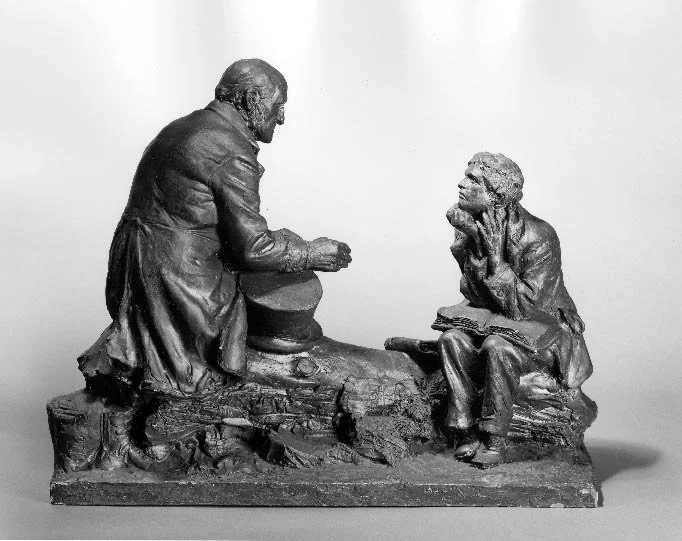
Williams College sculpture of Mark Hopkins on one end of a log and a student on the other
Though I’d be considered conservative on many educational matters, that would not accurately describe my views about the role in education of AI (artificial intelligence) and AGI (Artificial General Intelligence). Not only do I think that—going forward—AI will play a very large role in education. In many ways, that role can be constructive, both for individuals and for the broader human society.
While individualized relations between a tutor and a student can be ideal, this kind of relation has only been possible for the very few—Alexander III of Macedon, with his tutor Aristotle, or the mythical student at Williams College with its President Mark Hopkins seated on the other end of a log.
Now, however, with well-designed and artfully used AI tutors, it should be possible to give personalized education to every student. And that education can be as varied—or as uniform—as we would like.
IMPORTANT POINT #1: I am not taking the position that ALL of education, all of human-rearing, should take place via AI. Indeed, as I’ve contended in several essays, education in the future needs to draw on the wisdom of institutions like religion (including its humanistic variant).
IMPORTANT POINT #2: I am not arguing that the basics (reading, writing, calculating, and coding) should be consigned to AI or other computational systems. I favor traditional classrooms where 5- to 10-year-olds gain an initial mastery of these “basics”—with appropriate help for those who may have learning challenges. Of course, to the extent that computational tools can be of help, they should also be drawn on—as is already the case in some venues.
Rather: I draw on the methods and goals of progressive education—associated with scholars like John Dewey and Jerome Bruner, and scholastic models like Summerhill or Reggio Emilia. These approaches follow the interests of students, support them in pursuing these interests, and help them to deploy accumulated knowledge and skills in ways that make sense to them and—ultimately—to the broader society.
To introduce this way of thinking, I’ve taken the liberty of drawing on the well-received television series “Finding Your Roots.” In this PBS offering, scholar Henry Louis (“Skip”) Gates helps guests learn about their own heritage by following biographical, historical, and genetic clues and cues. (I recently wrote a blog on this series, linked here.)
Questions about one’s own family and genes intrigue (and often surprise) most people; such inquiries raise many issues and questions. Beginning with one’s own personal heritage, one can wander and ponder across the range of scholarly disciplines and approaches: geographical expanse, historical background, migration patterns, art forms that capture salient facets of one’s own background and journey, issues of finance, economics, probability as well as the deepest philosophical issues and conundra.
Feel free to add to these disciplinary treks.
Details of this list of entry points should not be dictated by curricular czars, nor should they be left totally to the current interests and preferences of the user. Rather, there should be a delicate ballet between what excites or intrigues the student, on the one hand, and the range of scholarly disciplines and “frames of mind” that an educated person should encounter, and, if fortunate, eventually gain some proficiency. No one should be forced to follow every trail, but no one should be allowed simply to “drop out.” Those who craft AI curricula and pathways should strive to achieve this balance.
So far, I am just recapitulating what I’ve mentioned in earlier presentations, essays, or blogs. (A few examples linked here, here, here, here, and here.)
In those presentations, I’ve insisted that one need not necessarily begin with genes—these just turn out to be alluring and convenient entry points for many of us.
Going forward, my task is straightforward:
Let’s say that, for whatever reason, you do not feel that genetics and genes are propitious entry points for a student—maybe even for your children or your grandchildren. Indeed, in cases where the genetic background is unknown or controversial or sensitive, there’s ample reason to identify and instead build on other entry points.

And so, given my proclivity (is it genetic? cultural?) to pun, let me simply assert that there are innumerable other possible entry points. I suggest here the entry points of jeans and jellybeans. If there are children who are not interested in clothing, I have yet to encounter them. Similarly, if there are children who are not attracted to sweets, they’ve escaped my attention. “Jeans” and “jellybeans” are often of interest in themselves. But I am not waving the flag for these particular entry points for stimulating the young mind.
Rather, here’s my suggestion: Just as one’s biological heritage is a promising entry point for many of us (as demonstrated by the enduring popularity of Gates’ television series), clothing and/or food can serve as alluring entry points for young students who ought to be exposed to a range of disciplines and perspectives.
To wit:
Geography: Where do these entities come from? Are there places where they are not found? How have they traveled?
History: How have they been conceived and how have they changed over time?
Economics, Finance, Mathematics: What do they cost, how are they priced, what is the supply and demand, what happens when there is some kind of strike or war? Are there convenient and inexpensive substitutes?
Anthropology, Sociology: What are the tastes and preferences for such entities in different parts of the world—yesterday, today, tomorrow?
Physics, Biology, Geology: How are they actually made, what are the constituent components, and in what ways have they changed over time—brief periods but also over the millennia?
Philosophy: Why should we care about issues like this? How have other thinkers approached them—what we eat and why; how we are clad and why? How do they relate to la condition humaine.
From another vantage point: Let’s say that you are a scholarly purist—and you are made uncomfortable by these child-friendly entry points.
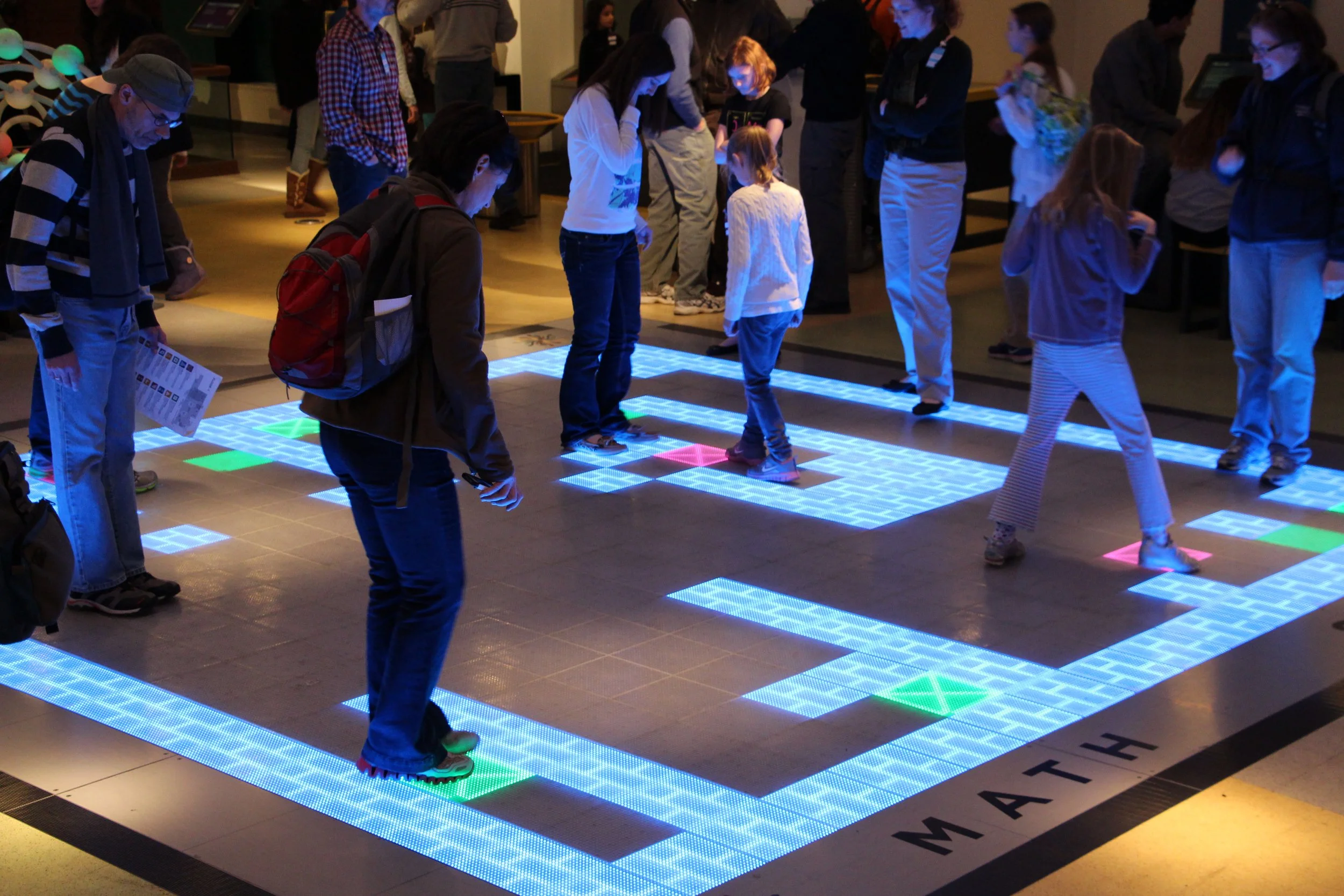
National Museum of Mathematics in NYC
A few months ago, I had the pleasure of visiting the just reopened National Museum of Mathematics in New York City. It’s an astonishing site—several dozen user-friendly exhibitions—take a look at their website here. While this blog was not on my mind at that time, it has since dawned on me that the museum itself offers an amazing range of “entry points” to the issues, questions, and palettes of mathematics. In my terms, it speaks to the palette of human intelligences—from bodily-kinesthetic to spatial to musical! And, as the website notes, it can reach visitors ranging from age 2 to 102!
Takeaways
I hope that you’ve been amused—and perhaps enlightened—rather than frustrated or infuriated—by this thought exercise. My goal has not been to convince or sell you a certain curriculum—though if it were of interest to Khan Academy or to Alpha Schools (just to mention two educational ventures currently embracing AI), that’s fine with me.
Rather, I want to suggest that children learners’ interests and passions are invaluable assets. And now, perhaps for the first time ever, we can draw on these personal inclinations and motivations to introduce young people to a curriculum or even the curriculum…and, indeed, to the excitement—the thrill—of learning, of using their minds, of becoming informed persons and interesting persons and perhaps, if we are fortunate, individuals motivated to do good work and to be good citizens…the perennial goal of progressive education!
But the latter goals cannot and should not be consigned to AI or AGI. Rather, in the educational landscape of the future, what we now consider middle or secondary schools should gradually transition into gathering places where we learn about our communities, its strengths, its needs, and how best to meet them—as well, as we get older, about the wider world, the planet on which we are fated to live and die. And, in particular, about the problems and challenges that we now face, and how can we draw on the range of disciplinary approaches to tackle these successfully. Here, the curriculum of our Good Project may be relevant. (Learn more here.)
To conclude: The sites that I am envisioning some decades from now are more like scouts and/or religious gathering places than like P.S. 1 or Your Town High—but if we want to call them schools-of-the-future, that’s fine with me.
ACKNOWLEDGMENTS
For their extremely helpful comments on earlier versions of this blog, I thank Kirsten McHugh, Annie Stachura, and Ellen Winner
REFERENCES
Bruner, J.S. (1960). The process of education. Harvard University Press.
Dewey, J. (1974). John Dewey, On Education: Selected writings. University of Chicago Press.
Neill, A.S. (1960). Summerhill: A radical approach to child reading. Hart Publishing.
