Do the Eyes Have It?
© Howard Gardner 2026
“Opa,” my ten-year-old granddaughter Faye said, in a questioning tone. “What is it like to be colorblind? What do you see? Can you learn to see colors?”
The question itself did not surprise me, because we had talked about colorblindness in the past. Like numerous other children whom I’ve encountered over the decades, Faye had more than once tried to teach me to see and correctly name colors—with, of course, no success.
But now the question seemed to be more serious—worthy of reflection.
My reflections began with my own childhood. Though she never had the opportunity to become a teacher, my mother Hilde (1911-2013) had studied “kindergarten education” in her native Germany. There she had learned about colorblindness and how this sex-linked trait was transmitted. Acting as a sleuth, she inferred that her father Martin (1877-1961) had also been colorblind. But for his entire life, Martin had consciously hidden this alleged weakness, e.g. asking for help in finding socks that matched, “because it’s dark.”
German males of his era were reluctant to admit any deficits.
Not only was I colorblind, but I had more than my fair share of other visual deficiencies. I lacked binocular vision and so could not see depth in the ways that others do. Various interventions, such as masking the stronger eye, were tried—alas, to no avail.
Skipping ahead, when I went to summer camp and picked up a rifle for the first time, my counselor declared me a lefty. I protested that I was right-handed—but when I asked my parents, my mother admitted that I had indeed begun life as a “lefty.” But again, in the spirit of those times, adults had consistently placed utensils in my right hand. And I was now a “righty”—except, apparently, at the firing range. (This practice of enforced right-handedness was common in Europe until the latter part of the 20th century and is still carried out in some countries.)
As I got older, I discovered further visual deficiencies. As a youth, I never had difficulty in recognizing other persons. But as an adult, I discovered that I could not recognize people just by their faces.
How did I discover this deficiency? When I would go to a conference, I might have dinner with someone and then fail to recognize them the very next day!...presumably because they had changed their hairstyle or their makeup or their manner of dress. Turns out that I am prosopagnosic (also known as “face-blind”)! This deficiency was not noticeable during my childhood because there were so many ways (size, pace and style of movement, dress, facial expressions) to recognize the small number of persons in my non-transactional world. Also, as pointed out by anthropologist Robin Dunbar, in the distant past, individuals only needed to recognize about 150 persons, and that sufficed for clubs, clans, and other collectivities. Not, however, for our globalist society, where one goes from one meeting—and sometimes one continent—to another.
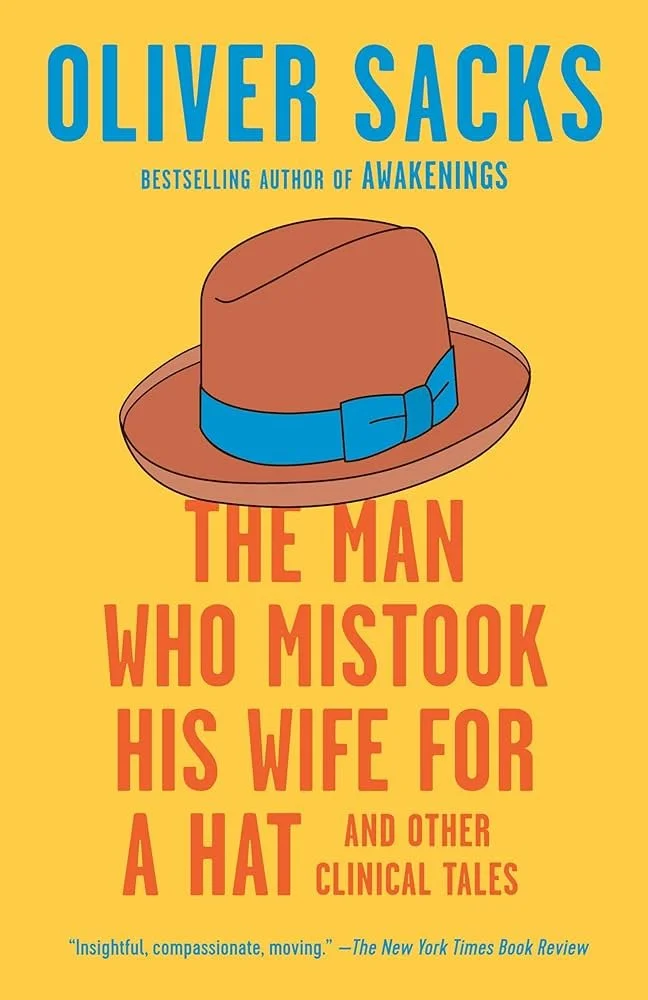
Nor, alas, was this deficiency restricted to me. When a member of my family read about this condition in an Oliver Sacks’s article in The New Yorker (based on his 1985 book The Man Who Mistook His Wife for a Hat), she realized that she too suffered from this condition, though with a milder case. And we inferred—retroactively—that my father had probably also been prosopagnosic. Therein lay one reason he did not like theater or movies—it’s difficult to recognize a character once there’s been a change of costume or milieu. (My wife Ellen will testify that this deficiency causes me to question, “Who is that?” following any change of scenes or costumes in a movie.)
Finally: I have long realized, at least at a conscious level, that I cannot remember scenes from the past. If I see a photograph I can readily recognize the persons and the situation, but left to my own devices, I have essentially no visual memory. (I am making the distinction here between recall and recognition memory.) To my own astonishment, I can’t even recall the layout of rooms and staircases in homes where I lived for a decade or more…or any details on the street where I lived.
Lest I seem like a “visual basket-case,” my memory for conversations and events is fine—and for facts and figures it is far better than average. Also, and somewhat surprisingly, I am quite good at recognizing photographs of well-known people, but I would need to be tested to determine whether I would recognize Abraham Lincoln or Eleanor Roosevelt or Albert Einstein if just shown the face without any of the predictable accoutrements—trim beard, wavy hairstyle, bushy moustache, respectively.
At last, there is a name for my long-recognized condition—I suffer from aphantasia (MacFarquhar 2025), the inability to remember scenes from the past due to a diminished recall memory of these scenes. But I can recognize these scenes if presented with photographs. So, for example, while I cannot visually recall a scene from the 1963 March on Washington, I would certainly have no difficulty recognizing a picture of the Washington Mall, with Martin Luther King addressing the crowd.)
My conversation with Faye helped me make an important distinction. With colorblindness, there is no way of teaching myself verbally to tell one color from another. In contrast, with face-blindness and aphantasia, I can use words or contrive phrases to help me remember faces and scenes.
You are no doubt wondering why I am reflecting on these matters…and do I—as a reader—really need an inventory of his deficiencies? Other than Faye’s reasonable questions, several factors have stimulated this reflection.
First of all, with the advent of computing, AI, various kinds of devices and accoutrements, none of these deficiencies will matter nearly as much in 2043 as they did in 1943—the year of my birth. There are—or soon will be—devices that will recognize just about everyone, that can store and instantly access a full swathe of scenes and scenarios from the past, and that can make up for my colorblindness and my lack of stereoscopic vision in one way or another. Good news for any great grandchildren of mine!
Next, these deficiencies also raise a raft of scientific questions. Why do individuals with these deficits still survive? In my childhood, my parents tried to comfort me by saying that, as a result of my colorblindness, I would not be fooled by camouflage in war! No one chooses to be blind or deaf, but individuals with these deficiencies have done extraordinary things—and indeed, Helen Keller was able to conquer both of these pathologies and inspire millions of us who learned of her accomplishments.

There is also the question of strengths independent of my visual problems. Even individuals who do subscribe to my “theory of multiple intelligences” would accept that I am quite good with language and with music—and those strengths have been a support throughout my long life. And despite my visual problems—or, just perhaps, because of my curiosity about them—I began my research career by studying how children perceive style in paintings; became deeply involved in visual arts education at Harvard Project Zero; and actually served for decades on committees and ultimately the board of New York’s Museum of Modern Art.
Also, echoing Faye’s curiosity at age ten, there is an autobiographical incident from my teenage years. My uncle Fred Gardner (originally Fritz, 1911-1990) was a careful observer of his nephew. When I was a teenager, he gave me a standard textbook in psychology—authored by Norman Munn (1944). I leafed through the textbook until I came to a page that startled me. It was about colorblindness and it showed—via Ishihara test cards—why I was unable to discern numbers that “normal individuals” easily see. It’s an exaggeration to say that I became a researcher in psychology because of Munn’s textbook or my visual challenges, but my interest was piqued by the knowledge that apparent disabilities could be understood—and perhaps, eventually, repaired.
Finally, for those interested in biology and genetics, the question arises about how each of these abilities—and disabilities—emerged across time and in different forms in different species and managed somehow to survive. Equally, for those interested in computation and engineering, the challenge is to build devices that can carry out these functions or supplement them in individuals who, to return to Faye’s question, are—through the rolling of the genetic dice—colorblind or tone-deaf or dyslexic.
Still, before I die, I would like to view the world in the way that “perfectly normal people” do—though I doubt that I would willingly sacrifice those skills on which I’ve drawn in my own personal and professional lives.
ACKNOWLEDGMENTS
I thank Kirsten McHugh, Annie Stachura, and Ellen Winner for their thoughtful comments on earlier drafts.
REFERENCES
Dunbar, R. (2010). How many friends does one person need?: Dunbar’s numbers and other evolutionary quirks. Harvard University Press.
Gardner, H. (2020). A synthesizing mind. MIT Press.
MacFarquhar, L. (2025). Some people can’t see mental images. The consequences are profound. The New Yorker.
Munn, N. (1946). Psychology: the fundamentals of human adjustment. Houghton Mifflin.
Sacks, O. (1985). The man who mistook his wife for a hat. Summit Books.
