Rethinking Classroom Assessment
© Jie-Qi Chen 2026
In the preceding blog, I described my involvement with Project Spectrum. This initiative explored children's intellectual capacities across a wide range of domains, used intelligence-fair materials, and emphasized children's intellectual strengths rather than deficits.
As I worked with Spectrum, I became aware of two challenges—perhaps unintended consequences of its very strengths. These challenges have significantly shaped my work in the decades that followed.
First: Spectrum's emphasis on identifying individual intellectual strengths sometimes led educators to pay less attention to how children's abilities emerge and develop through interactions with peers and adults.
Second: While Spectrum offered rich portraits of children's abilities across a range of domains, the connection between these intellectual profiles and everyday classroom teaching was not always clear.
These questions led me to develop Bridging Assessment, an approach designed to connect assessment with curriculum and instruction while capturing individual children's learning as it unfolds through social interactions.
Bridging is structured around curriculum areas, such as language and literacy, mathematics, arts, and STEM. Each area includes instructional routines—playful, engaging activities that serve a dual purpose: supporting children's learning while giving teachers opportunities to observe and document their development.
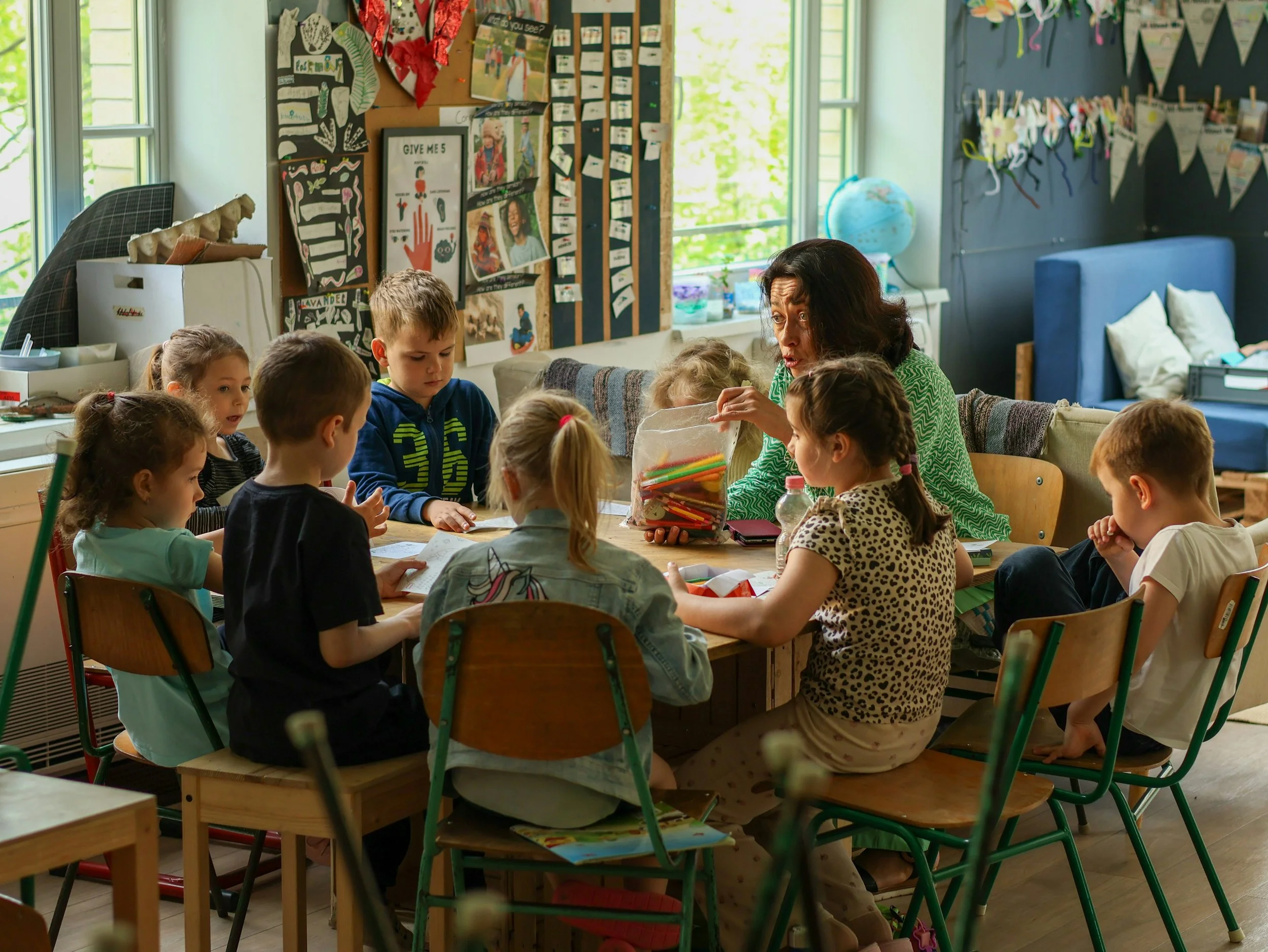
Consider “Notice and Wonder Photo Chat”, a routine for developing oral language and communication skills. The teacher shows a small group of children an interesting photograph and invites them to share what they notice and wonder about. As children describe, question, listen, and respond to one another, the teacher can observe not only each child's language and reasoning but also how children build on one another's ideas. A child who initially offers only a few words may elaborate after hearing a peer's observation, revealing abilities that might not emerge in an individual assessment.
Used regularly throughout the year, these routines allow teachers to gather evidence of children's learning over time and use it to guide instruction.
For me, Bridging extends Spectrum's commitment to recognizing children's strengths through meaningful activities while moving assessment into the social and curricular contexts of everyday classroom learning. Rather than treating assessment and teaching as separate activities, Bridging brings them together.
Domain-Specific Teaching and Learning
Early childhood educators have traditionally been trained as generalists, emphasizing whole-child development. Yet nurturing the whole child also requires understanding how children learn within specific domains. Project Spectrum helped me appreciate this perspective.

For each domain, Spectrum identified key abilities essential to successful performance, such as numerical reasoning and logical problem-solving in mathematics, or body control and sensitivity to rhythm in movement. Working with colleagues to identify these abilities taught me the importance of understanding the particular knowledge and ways of thinking within each domain.
Years later, when I founded the Early Math Collaborative at Erikson Institute in Chicago, this perspective informed our work. Our team of five spent our first year identifying what we called the Big Ideas of Early Mathematics—fundamental concepts that organize children's learning and provide a foundation for more advanced mathematical thinking.
Consider counting. Young children love to count everything, from the stairs they climb to the crackers they eat. Yet understanding counting involves more than reciting numbers. One Big Idea is that counting can be used to find out how many objects are in a collection. Recognizing that the last number spoken when counting represents the quantity of the entire collection is a major conceptual achievement for young children. This understanding helps teachers move beyond teaching children to recite numbers and toward supporting their understanding of quantity.
Developing Big Ideas reinforced my conviction that early childhood teachers need a deep understanding of the content they teach. After all, you have to understand what you are teaching to teach for understanding. When teachers understand the underlying mathematical ideas, they are better prepared to recognize children's emerging understanding and create meaningful learning experiences.
Looking back, I see a clear connection between Spectrum's key abilities and our Big Ideas of Early Mathematics. Both grew from the conviction that learning within a domain has its own structure and that understanding this structure matters for teaching. Spectrum helped me appreciate the importance of identifying what is fundamental within a domain. My work in early mathematics carried that insight further, from identifying important abilities to understanding the concepts that organize children's learning.
Project Spectrum also held deep personal meaning for me. I grew up in China during a time when people were judged not only by what they did, but also by their family background. When I was two, my father was imprisoned as a “historical counterrevolutionary.” And my family was labeled a “black family,” subjected to discrimination, humiliation, and poverty.

At school, I was classified as “a child who can be educated”—meaning that although I had inherited my family's supposed political faults, I might still be reformed through proper ideological education. Growing up with such labels, I learned to question my own worth.
MI theory and working with Project Spectrum gave me a profoundly different way of thinking about human abilities and potential. Rather than defining children by a single measure, Spectrum sought to discover their strengths in many different ways.
Looking back, I realize that Project Spectrum gave me more than new ways to understand children's abilities or improve educational practice. Through the ideas that inspired it, Spectrum helped me rethink something I had been taught to believe about myself. Spectrum strengthened a conviction I have carried ever since: No child should have to prove that they are worthy of being seen, respected, and given the opportunity to learn and grow.
ACKNOWLEDGMENTS
I thank Howard Gardner and Mara Krechevsky for their thoughtful comments and suggestions on earlier drafts of this blog.
REFERENCES
Krechevsky, M. (1998). Project Spectrum: Preschool assessment handbook. New York: Teachers College Press.